Roof Drain and Scupper Service in Columbus, GA

Commercial Roofing Services
Roof Drain and Scupper Service in Columbus, GA

Keeping Rainwater Moving Off the Roof, Not Sitting on It

Standing water is the single fastest way to shorten a flat roof's life, and most ponding problems trace back to a clogged or undersized drain rather than a structural slope issue. We clear, repair, and reassess drainage before it becomes a bigger job on your capital budget.

Why Ponding Is a Bigger Problem in Columbus Than It Looks

Summer thunderstorm cells here can drop a significant amount of rain in a short window, and a drain running slow or partially clogged during that kind of downpour leaves standing water on the membrane for hours or days afterward. UV breakdown and membrane degradation both accelerate under standing water compared to a roof that sheds properly.

Buildings with internal drains, common on the larger distribution and manufacturing roofs off Airport Thruway and Psalmond Road, are especially dependent on those drains staying clear, since there is often no gravity-fed overflow path to catch a clog.

Clearing Debris Before It Becomes a Clog

Leaves, roofing granules, and construction debris from nearby projects are the most common culprits we find inside drain bowls and scupper openings. We clear strainers and check the drain body itself, beyond the visible opening, since debris can lodge further down the line out of sight.

On roofs near tree cover or ongoing construction activity, we recommend more frequent drain checks than the standard maintenance schedule, since debris accumulates faster than a twice-a-year visit can reasonably keep up with over a full year.

Repairing Failed Drain and Scupper Flashing

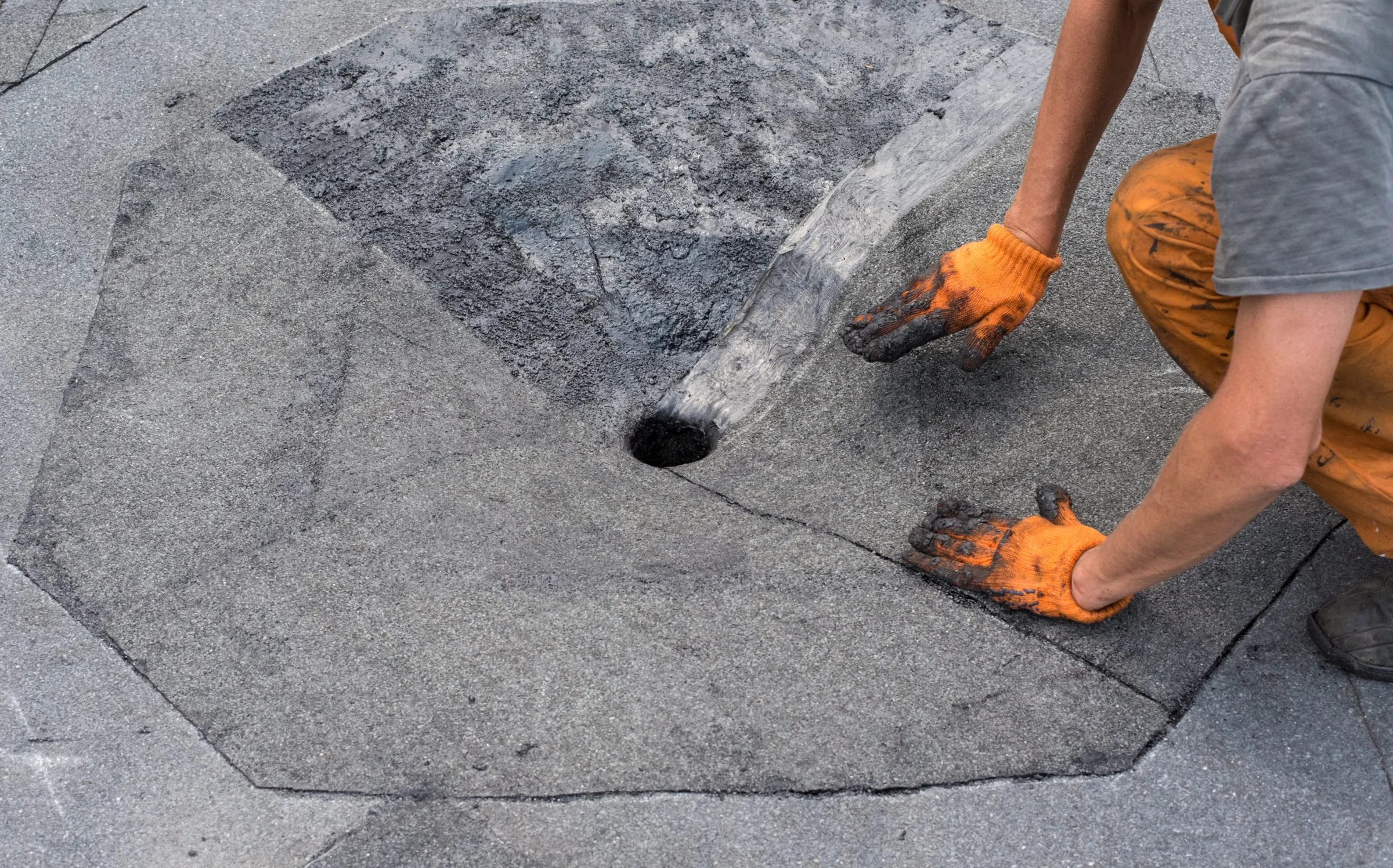
Drain bowls and scupper openings are common leak points even when the drain itself is clear, because the flashing seal around the fitting degrades over time from constant water contact. We reseal or replace that flashing as part of any drain service call where it shows wear.

Scuppers on parapet walls also get checked for proper slope and clearance, since a scupper installed slightly high relative to the roof surface will always leave a puddle behind it no matter how clear the opening is.

Overflow scuppers, the secondary opening set slightly higher than the primary drain, get the same inspection even though they rarely see water, because a blocked overflow only becomes a problem the one time the primary system actually fails during a heavy storm.

  • Drain strainers and bowls cleared of leaves, granules, and debris
  • Drain body checked below the visible opening for lodged debris
  • Flashing around drain and scupper fittings resealed where worn
  • Scupper slope and clearance checked to prevent standing puddles
  • Ponding depth and duration tracked when slope issues are suspected
  • Tapered insulation or slope correction discussed for chronic low spots
  • Drain condition checked as a standing item on every maintenance visit

When Ponding Points to a Slope Problem

If a low spot holds water even with clear drains, the issue may be structural settling or an original design flaw rather than a maintenance issue. In those cases, we discuss tapered insulation or a targeted slope correction rather than repeatedly clearing a drain that was never going to solve the underlying problem.

We measure ponding depth and duration over multiple visits when the cause is not obvious, since a one-time observation after a storm is not enough on its own to diagnose a chronic slope issue with confidence.

Building Drainage Checks Into Your Maintenance Routine

Drain and scupper condition is part of every scheduled maintenance visit we run, timed ahead of Columbus's spring storm season so the system is clear and ready heading into the months with the heaviest rain totals of the year.

Drainage on School and Institutional Campuses

Muscogee County school buildings and other institutional campuses around town often run large low-slope roofs with multiple internal drain zones added across different construction eras, and a clog in one zone will not show up as ponding anywhere near an unrelated section, which makes a full-roof walk more important than checking the areas that have leaked before.

We schedule these visits around the academic calendar where a client asks, favoring summer break or holiday weeks so drain work does not put a lift or ladder anywhere near students or staff during the school day.

Drain and Scupper Questions

How much standing water is actually a problem?

Any water still standing forty-eight hours after rain stops is worth investigating. Occasional shallow ponding that drains within a day is common on flat roofs, but persistent standing water accelerates membrane wear.

Can a clogged drain cause a leak even without visible ponding?

Yes. Water backing up around a poorly sealed drain fitting can work its way under the membrane at the flashing seam even if the surface looks like it drains fine most of the time.

How often do internal drains need to be checked?

Twice a year at minimum, more often on roofs near tree cover or active construction where debris accumulates faster.

Is ponding always caused by a clogged drain?

No. If drains are clear and water still collects in the same spot, it usually points to a structural slope issue or original design flaw, which needs a different fix than drain clearing.

Do you repair scupper flashing or just clear the opening?

Both. Clearing debris solves an active clog, but if the flashing around the scupper is degraded, we reseal or replace it so the fitting itself is not the next leak source, and we note the repair in the visit summary.

Ready to review the roof scope?
Roof Help

Commercial Roofers of Columbus

Commercial Roof Drainage and Ponding Repair in Columbus

Roof Drainage and Ponding Review for Columbus commercial properties starts with the condition in front of the owner. The field record must explain slow roof drains, blocked strainers, backed-up leaders, leaking drain bowls, undersized scuppers, missing overflow paths, or ponding that remains after rainfall, separate immediate protection from permanent work, and show how the findings affect repair, restoration, replacement, maintenance, and future capital decisions.

Request Commercial Roof Help

Make repair, restoration, and replacement distinct decisions

The decision point is whether cleaning is enough, whether a drain or flashing detail needs repair, or whether chronic slope and capacity problems require redesign. The evidence may support a small permanent repair, a broader corrective scope, a restoration evaluation, recover design, or tear-off, but the report needs to show why. The option matrix should address present failure, remaining risk, investigation still required, installation disruption, anticipated service interval, and future maintenance. Unknown inputs should be visible rather than buried in an allowance. A smaller scope is not automatically prudent, and a larger scope is not automatically safer. The defensible option is the one whose boundaries match the documented condition and the owner's operating requirements.

Turn the visit into a usable next step

The practical handoff is a roof-condition review that connects drainage failures to membrane and insulation performance. The next person should receive the property address, roof-area identifiers, contacts, access notes, photographs, temporary measures, completed work, open recommendations, and timing. For one building, that history makes the next visit faster and reveals whether a repair held. Across a portfolio, it lets ownership rank roofs by condition, operational risk, repair spending, and capital timing instead of reacting to the newest ceiling stain. Recurring service should not disappear when a capital project begins. Commercial Roofers of Columbus can preserve the agreement and roof history while larger work is scoped, completed, closed out, and returned to inspection status.

A useful response starts before roof access

Before dispatch, collect the address, responsible building contact, safe access route, occupied area below the problem, time and behavior of the leak, known roof type, and any temporary protection already attempted at the Columbus property. If the building has prior reports, warranties, repair invoices, roof plans, or known drain locations, those records can shorten the investigation. They should be treated as history to verify, not as proof that the present failure has the same cause. That intake determines whether the immediate need is interior protection, controlled roof access, weather-limited stabilization, drainage attention, or a scheduled diagnostic visit. It also gives the crew a safer and more focused starting point.

Price the known work without hiding the unknowns

The owner should see the boundary between the base scope and contingent work. That includes moisture limits, substrate repair, additional layers, damaged deck, blocked piping, inaccessible details, hazardous materials, and work by other trades. Exclusions should not function as an escape hatch. Each exclusion needs a reason and, where practical, a defined way to resolve it through testing, access, document review, engineering, or a unit-price condition discovered during construction. When assumptions are visible, the owner can decide whether to investigate further before award or carry a controlled contingency. Either choice is stronger than discovering that two supposedly comparable bids covered different roofs.

How Columbus operating conditions shape the review

A Columbus roof review has to account for heavy thunderstorms, high heat, humidity, wind-driven rain, and tropical weather remnants. Those conditions affect access, observation timing, drying, and temporary protection before they affect the final recommendation. Interior evidence should be mapped to a roof elevation before anyone chooses a drain, wall, curb, seam, penetration, or edge as the cause. Water can move laterally through insulation, along deck flutes, or down structural elements and appear away from the opening. The useful question is not simply whether work can be performed. Record what was observed, what remains an inference, and what weather, access, equipment, overburden, or concealed construction prevented the crew from confirming.

Build a roof record another decision-maker can use

The core deliverable is a record of water depth and duration, debris, drain and scupper condition, membrane terminations, interior staining, discharge restrictions, roof slope, overflow provisions, and repeated ponding locations. Commercial Roofers of Columbus should be able to hand that record to ownership, a facility manager, or another contractor without a separate verbal explanation. During the visit, the technician should follow water from the roof field through low points, sumps, drain bodies, clamping rings, scuppers, leaders, overflow openings, and safe discharge points. Wide views, detail views, measurements, markings, and interior references make the findings reproducible instead of dependent on memory. Observed facts, recommended actions, completed work, and open items should never share one unlabeled list. Separating them lets an off-site approver see exactly what was authorized and what still needs a decision.

Do not force different roof systems into one repair assumption

Roof-system identification changes the diagnosis. Around Columbus, the target page inventory includes Modified Bitumen Systems, Silicone Roof Coating, and Spray Polyurethane Foam, each with its own seam, flashing, fastener, and compatibility questions. Record membrane type, surfacing, insulation and cover-board clues, attachment, flashings, penetrations, edges, and earlier repairs. If the assembly cannot be confirmed visually, say so and define the core or document review needed to confirm it. Drainage stays in the analysis because a sound patch cannot correct water held against a curb, an overloaded outlet, or settlement at a low point. System language should support whether cleaning is enough, whether a drain or flashing detail needs repair, or whether chronic slope and capacity problems require redesign instead of functioning as a product catalog.

Keep the occupied building in the scope

Building operations change how the same roof work is performed. On Property Management Firms, Healthcare Systems, or Insurance Restoration, access, interior sensitivity, security, and working hours can define the safe sequence. The pre-work review should locate safe access, occupied areas, shutdown constraints, fire or security procedures, rooftop equipment, pedestrian controls, and interior protection. The building contact should know which decisions are needed before mobilization. Wet-weather work may stop at stabilization because permanent materials need a clean, dry substrate and a workable forecast. Daily closeout should state what was opened, completed, and left under temporary protection.

Columbus decision checklist

  • Map the interior symptom to a named roof area before selecting a repair detail.
  • Record temporary measures separately from permanent work and list every open item.
  • Verify drainage, penetrations, walls, edges, earlier repairs, and transitions around the affected area.
  • State the observed roof assembly, unknown construction, access limits, and testing assumptions.
  • Connect the recommendation to repair, restoration, replacement, maintenance, or capital-planning thresholds.
  • Set the next inspection or follow-up date so the roof history continues after this visit.

Commercial roof decision questions

Does this condition automatically mean the roof must be replaced?

No. The review should establish whether cleaning is enough, whether a drain or flashing detail needs repair, or whether chronic slope and capacity problems require redesign. Replacement becomes a defensible recommendation only when the field evidence, moisture, assembly condition, repair history, deck or attachment concerns, and lifecycle comparison support it.

What should the Columbus roof scope document?

It should document water depth and duration, debris, drain and scupper condition, membrane terminations, interior staining, discharge restrictions, roof slope, overflow provisions, and repeated ponding locations. It should also label temporary and permanent work separately, state assumptions and exclusions, and identify the inspection or service step that follows the current scope.

How does an urgent call become a maintenance or capital plan?

The immediate visit creates the first roof-area record. A follow-up inspection establishes condition and priorities. Completed repairs, recurring observations, drain service, warranties, and future recommendations are then retained so maintenance stays scheduled and larger work can be placed into the appropriate capital year.

From service call to roof plan

Use the next decision, not the biggest sale.

Stabilize the problem, document the roof, compare the viable paths, and keep the resulting roof history active.

Request commercial roof help